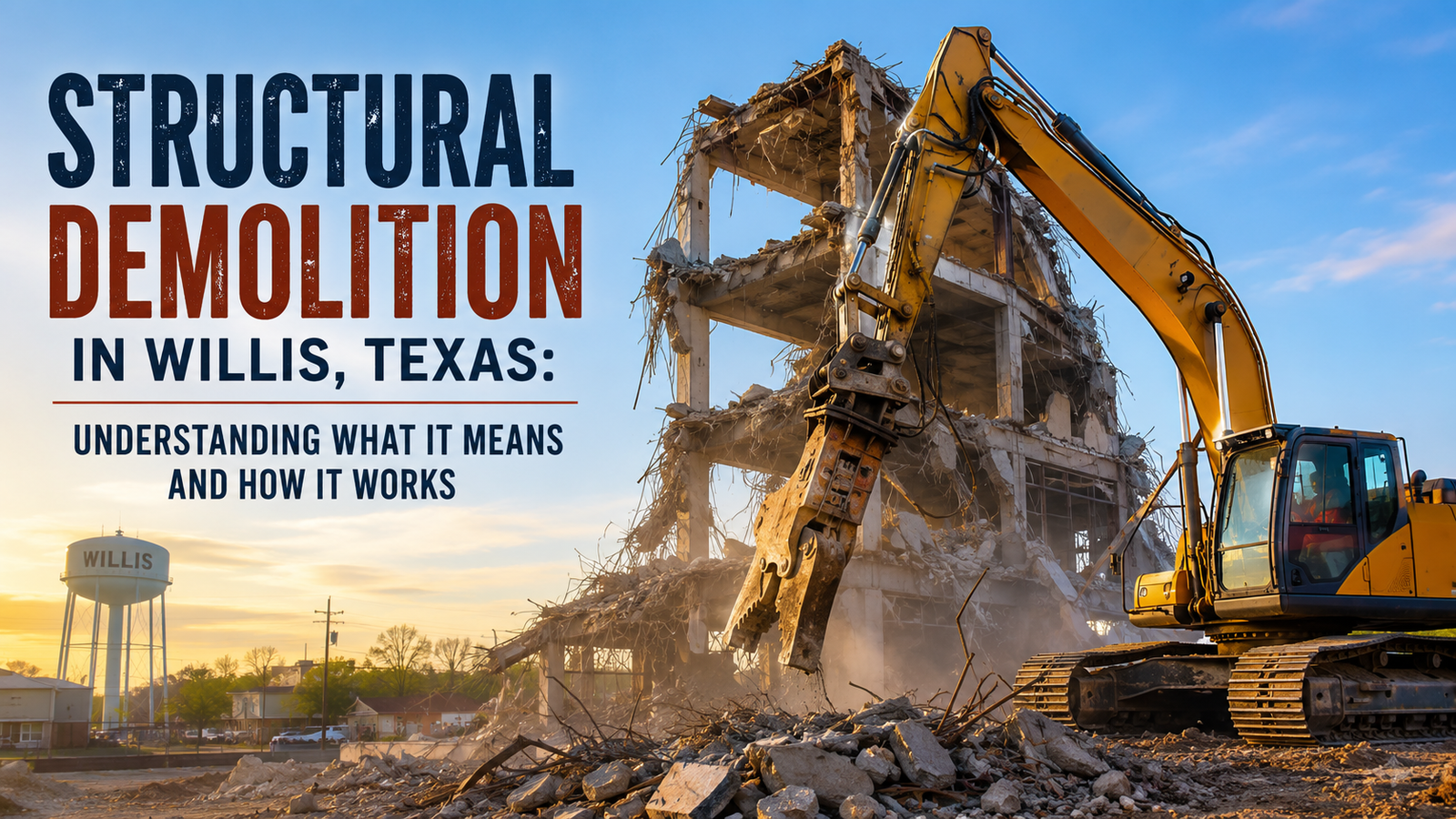
The term “structural demolition” comes up frequently in construction and redevelopment conversations, but its precise meaning is not always clearly understood. Structural Demolition Willis refers specifically to the removal of a building’s primary load-bearing components the walls, columns, beams, floors, and foundation systems that give the building its structural integrity. This distinguishes it from interior or selective demolition, which removes non-structural elements while leaving the structural frame in place, and from deconstruction, which disassembles materials by hand for salvage. In Willis, Texas, structural demolition is a regularly performed service that serves both full-teardown projects and partial structural modification projects within existing buildings.
What Makes Structural Demolition Technically Distinct
Structural demolition is technically more demanding than non-structural interior work because it involves removing components on which the building’s stability depends. When a non-structural partition wall is removed, nothing changes about how the building stands. When a load-bearing wall, structural column, or primary beam is removed, the loads those elements were carrying must be redirected through the remaining structure or through temporary support systems. Without that load management, structural failure can occur and structural failure during demolition is a serious safety risk.
This is why structural demolition requires expertise in how buildings are actually built. A contractor performing structural demolition must understand construction systems well enough to read the structure to identify which elements are load-bearing and which are not, how loads travel through the structure, and what sequence of removal is safe. In older Willis-area buildings where original construction drawings may not be available, this structural reading ability depends on field experience and sometimes on consultation with a structural engineer.
The specific definition given by industry sources is instructive: structural demolition focuses on removing the primary load-bearing components of a building, such as columns, beams, walls, and foundations. It is typically required when a building is structurally unsound, no longer meets current standards, or needs to be removed to make way for new construction. It is a highly technical process that involves detailed planning, specialized equipment, and strict adherence to safety and environmental protocols.
Types of Structural Demolition in the Willis Area
Full structural demolition of an entire building is the most comprehensive scope the complete mechanical removal of a structure from its foundation, leaving a cleared site. This is what most people picture when they think of demolition: an excavator tearing down a building. In Willis and Montgomery County, full structural demolition is performed on residential homes, commercial buildings, agricultural structures, and outbuildings when those structures are being completely removed from a property.
Partial structural demolition involves the removal of specific structural components from a building that will otherwise remain standing. This type of work is most common in building modifications and additions removing a load-bearing wall between two rooms to create an open floor plan, demolishing one wing of a building that is being reconfigured, or removing structural floor elements to create an opening between two levels. Partial structural demolition is technically the most demanding category because it requires load management, temporary shoring, and careful sequencing to maintain the stability of the structure throughout the work.
Foundation demolition is a specialized category of structural demolition. After the above-grade portion of a structure is removed, the foundation concrete slab, footings, grade beams, and any below-grade structural elements must also be demolished and removed when complete site clearance is required. In Willis, foundation demolition involves hydraulic breaker attachments on excavators to fracture the concrete, manual or mechanical separation of steel reinforcement, and hauling of the broken concrete to recycling facilities.
Structural Demolition Methods Used in Willis
Mechanical demolition with excavators is the standard method for full structural demolition in Willis and the broader North Houston area. Excavators in the 20-to-50-ton range are the workhorses of full structural demolition, capable of efficiently breaking apart wood-frame, masonry, and light steel structures. For larger commercial or industrial structures, larger excavators with high-reach booms can work from the top down on multi-story buildings without requiring crews to work at elevation.
Demolition attachments significantly extend the capabilities of excavators in structural demolition. Hydraulic breakers fracture concrete foundations and masonry walls. Demolition shears cut through structural steel efficiently. Grapple attachments grip and control debris as it is broken loose, allowing more precise material handling and reducing the scatter of demolition debris. The selection of attachment depends on the material type and structure being demolished.
Manual structural demolition using hand tools sledgehammers, reciprocating saws, and cutting equipment is used in specific applications where machine access is impossible or where precision is required. Partial structural demolition within an occupied building, for example, may require manual methods to work in confined spaces adjacent to elements that must be preserved and to control dust and debris more tightly than a machine could.
Burn-in-place is a debris management option that is specific to Willis’s rural and semi-rural context. After structural demolition of a wood-frame building, the combustible debris framing, siding, flooring, roofing can sometimes be burned on site under a proper Texas Forest Service or local burn permit. This significantly reduces hauling requirements and disposal costs. Non-combustible structural elements (concrete, steel, masonry) still must be separated and hauled regardless.
Safety Planning for Structural Demolition
Structural demolition is classified as a high-hazard activity by OSHA and Texas DSHS, and the safety planning requirements reflect that classification. Pre-demolition structural assessment identifies potential collapse hazards deteriorated structural elements, weakened connections, and unstable conditions that could create unexpected failures during demolition. This is particularly important in Willis for older or flood-affected structures where visible conditions may not fully reveal the extent of structural compromise.
Site security during structural demolition protects the public and neighboring properties. Temporary fencing, barrier tape, and signage establish a clear exclusion zone around the demolition footprint. Equipment operators maintain awareness of the collapse zone the area into which demolished material could fall and ensure no personnel or equipment are in that zone during active demolition activity.
Dust suppression is a continuous requirement throughout structural demolition. Water misting systems or water trucks are used to knock down dust during active breaking and loading operations. This protects workers and neighboring properties from construction dust, and in Willis’s semi-rural neighborhoods where properties are often more spread out, dust management is generally more manageable than in dense urban settings.
Structural Demolition and Soil Conditions in Willis
Willis sits on the same expansive clay soil system that characterizes much of Montgomery County and the North Houston region. This soil behavior swelling when wet, contracting when dry has implications for structural demolition work. Foundation systems in Willis often show evidence of soil movement over their lifetime, including cracking, differential settlement, and heaving. This means that Willis foundations are sometimes in a compromised condition even before structural demolition begins, which reinforces the importance of pre-demolition assessment.
After structural demolition and foundation removal, the site is left with disturbed soil in the foundation void and the surrounding disturbed grade. Proper backfill and compaction of the foundation void is essential poorly backfilled excavations in clay soil will settle unevenly as the clay cycles through wet and dry conditions, creating depressions that affect drainage and surface usability. The Willis demolition permit requirement for post-demolition site grading to drain reflects this practical reality.
Common Questions About Structural Demolition in Willis
What is the difference between structural demolition and interior demolition? Interior demolition removes non-structural interior components while leaving the structural frame intact. Structural demolition removes load-bearing walls, beams, columns, foundations, and other primary structural elements. Structural demolition requires more extensive planning, load management, and engineering awareness than interior demolition.
Is partial structural demolition (removing one load-bearing wall) dangerous? It can be, if not properly planned and executed. Removing a load-bearing wall transfers its loads to adjacent structural elements, and those elements must be assessed to confirm they can carry the added load. Temporary shoring is required during the transition period. In Texas, structural modifications typically require a building permit and engineering review.
How long does structural demolition take in Willis? Full structural demolition of a typical residential home in Willis takes one to three days. Larger commercial structures take longer depending on size and construction type. Partial structural demolition within an existing building is more variable depending on the specific scope, access constraints, and whether load management requires temporary shoring installation.